






When I was invited to join the crew planning the Protopian Prize, my first question was “What’s protopian?” I’m familiar with all sorts of hopeful SF categories, from solarpunk to policy fiction. But despite my suspicion that I’d probably already written some, the term was new to me.
Protopian stories, so named by Wired co-founder Kevin Kelly, depict futures that are achievable and optimistic—neither flawless nor catastrophic nor static, but workably better than what we have now. (Kind of like A Half-Built Garden (minus the aliens), so it turns out I had indeed written some.)
There are many reasons to read and write protopian fiction, but one of them is that a surprising number of the people working for better futures have trouble imagining them. Democracy 2076 found that democracy activists focused on what they’re trying to prevent, unable to picture plausible futures that they can work toward… They find this frustrating and disempowering—they want these stories.
This fits my own experience too—when I’m depressed about the state of the world, I often want a kickstart from someone else’s brain. I want cool ideas and adventure, but also a sense that we could pull some of those ideas out into real life. I joined the Protopian Prize committee to help bring more of these stories into the world.
Here are five books that I’ve already enjoyed that show futures that are worth working toward—please mention your own recommendations in the comments!
The Wildcraft Drones by T.K. Rex

What if we rebuilt civilization around a very different model of agriculture, slowly replacing monocultured farms with resilient food forests? Rex’s linked short stories cover several centuries of rewilding, automation, and debate and protest over the role of humans in Anthropocene ecosystems. None of the time periods are perfect—the flaws of one often provoke the plot of the next—but all have their advantages and I can imagine living, working, and arguing in any of them. I can also imagine eating, with pleasure, in any of them.
You could start toward this future by visiting your local food forest or community garden, or doing some guerrilla seed planting if you don’t have either.
In the House of Aryaman, A Lonely Signal Burns by Elizabeth Bear

Aryaman is part of Bear’s larger world centered on the technology of “rightminding.” The terminology is Orwellian, but the tech is actually a collection of tools to give people greater say in their own mental health care. It includes everything from exercise to therapy to measuring your neurotransmitter levels and adjusting your medications as needed.
This murder mystery is the earliest of the stories chronologically, set 50 years from now and featuring such advanced mood-management techniques as a treadmill desk. By the time of Ancestral Night, many thousands of years later, you can set your brain for hyperfocus or crisis readiness on demand—but the central ideas remain the same. People should have agency over their own minds, mental health treatment should be based around consent, and society should encourage us to prioritize each other’s well-being.
You could start toward this future by advocating for better mental health coverage in your local medical system, or by learning conflict mediation techniques.
Infomocracy by Malka Older

In the near future, Information rules the world. Or, rather, they rule the way the world is ruled—they run the elections through which neighborhoods vote on what government they’ll join for the next decade. They also run the fact-checking that keeps the elections fair, aided by ninja researcher-enforcers. It’s a little bit cyberpunk and a little bit policy wonkery. It passes my test for future-of-politics stories, which is that I come out with really strong political opinions about a world that doesn’t (yet) exist—don’t approve the mantle tunnel! Vote for Policy1st! Elections should be far enough apart to give governments real power! At its core, it’s about finding the right scale for meaningful democratic decisions, and protecting the institutions that are necessary for democracy to work at all.
You could start toward this future by supporting local journalists who investigate and share accurate news, or by protecting the polls at the next election.
When There Are Wolves Again by E.J. Swift
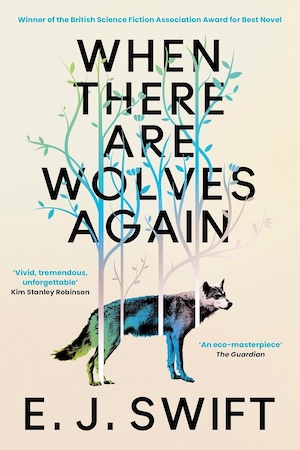
Hester is a documentary filmmaker who has followed the slow rewilding of England over fifty years, accompanied by beloved wolf-dogs whose ancestor she rescued from the Chernobyl Exclusion Zone. Lucy is an activist who learned to care for nature from her grandparents during the COVID-19 outbreak, and has spent the years since fighting to reclaim the commons so that everyone can make those connections. In 2070 the two talk around a campfire, reminiscing about their roles in changing the world but also about their loves and griefs. It feels gentle in parts, but also gut-wrenching. We see the importance of their individual choices, and of the communities in which they’re embedded. I did spot a four-star review complaining that there aren’t enough wolves, and it’s true that it’s more a book about wanting wolves than having them. Or maybe it’s a book about the possibility of wolves, and why you should want them, and the long fight needed to get them.
You could start toward this future by checking out nearby rewilding efforts—in the Netherlands, we have bison in the dunes! Or you could follow Antonia Malchik’s writing about reversing commons privatization.
Woman on the Edge of Time by Marge Piercy

I dithered about including this, because the future sections are framed like a classic utopia. Connie, pulled mentally forward from the misery of a 1970s mental institution, gets a tour of everything that’s great about Mouth-of-Mattapoisett. But tour guide Luciente is clear that it’s a work in progress, and that they are constantly debating changes to their society. It’s also the book that first convinced me that there are alternatives to corporate-defined progress. It exposed me to ideas about queer liberation, about gender non-essentialism, about equity, about ecological care, that I’ve been fighting toward ever since. It was the first place I ever encountered a scene with a man nursing a baby—something that at least one reviewer objected to when I put it in A Half-Built Garden 47 years later, suggesting that we’ve still got some work to do. Maybe a lot of work, but worth doing.
You could start toward this future by protecting trans kids from outdated ideas about gender, or by organizing for better ‘village’-level child care.

Everything for Everyone by M.E. O’Brien and Eman Abdelhadi
Mercenary Librarians trilogy by Kit Rocha
A.E. Marling’s Solarpunk novels.
Naomi Alderman’s The Future.
The Great Transition by Nick Fuller Googins
Gamechanger and Dealbreaker by L.X. Beckett